Migrating this site to EmDash
This site has changed CMS more times than I can count since 2003. This time I moved to EmDash on Cloudflare, and the reason is that most of my building now happens alongside an AI agent.
Read more Roger Stringer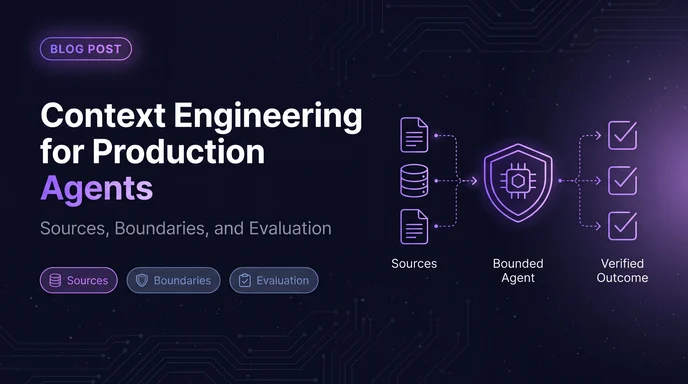
When I wrote _Context Engineering: The Craft of AGENTS.md_, the focus was entirely on the repository. The goal was to give a coding agent enough durable knowledge (architecture rules, naming conventions, testing procedures) that it stopped guessing and started acting like a capable junior engineer who actually read the onboarding docs.
That solves the repository problem. But when you move from a coding assistant on your laptop to an autonomous agent running in production, the stakes change. A production agent does not just need onboarding documents; it needs a runtime environment. It needs to know what evidence to trust, which actions are safe, when to stop, and how its work will be judged.
This is the operational side of context engineering. It is the shift from treating an agent as a prompt-in-a-loop to treating it as a production dependency. The model is not the agent. The production system is the agent.
In this guide, we will break down how to engineer the context package that surrounds a production agent. We will cover how to structure an evidence supply chain, how to enforce boundaries that keep the useful thing the safe thing, and how to build evaluations that judge the outcome rather than the confidence.
The most common failure mode in early agent deployments is the "junk drawer" system prompt. A team realizes the agent is making mistakes, so they paste in the employee handbook, the API documentation, the last five customer transcripts, and a list of thirty rules that all begin with "NEVER."
As Anthropic notes in their research on effective context engineering, context is a finite resource with diminishing returns. [1] Large language models suffer from context rot: as the haystack grows, the model's ability to reliably find the needle degrades. Every new token introduced depletes the model's "attention budget." [1]
Instead of a giant prompt, a production agent needs a versioned context contract. This contract defines exactly what the agent knows, what it is allowed to do, and what constitutes a finished job. Every item admitted to the context must have a clear job, an identifiable owner, and a refresh policy. If a piece of context does not change the agent's behavior or prevent a specific failure, it should be removed.
A production agent operates on evidence. If you feed it stale data, it will confidently execute the wrong action. Context engineering requires designing an evidence supply chain that distinguishes between four classes of information.
| Source Class | Description | Examples | Authority & Freshness Rule |
| --- | --- | --- | --- |
| Stable Operating Instructions | The foundational rules, tone, and escalation paths. | System prompts, constitution.md, tool schemas. | Version-controlled and deployed with the application code. |
| Authoritative Runtime Facts | The ground truth required to make a decision. | Live database queries, CRM records, current inventory. | Retrieved just-in-time via tools; never cached in the prompt. |
| Task-Local User Input | The specific request or trigger event. | An incoming email, a webhook payload, a Slack message. | Validated and sanitized before reaching the agent. |
| Working State | The agent's memory of what it has done so far on this task. | Tool execution results, intermediate decisions, active errors. | Compacted regularly; cleared when the task completes. |
That first row is its own discipline. If you have never written a constitution for an agent, _The Agent's Self_ is the long version of how to give one a stable identity and voice that survives contact with production.
The rule for evidence is simple: just-in-time retrieval beats preloading. Rather than stuffing a massive knowledge base into the context window, give the agent lightweight references such as file paths, stored queries, or search tools, and let it pull exactly what it needs. [1] When sources conflict, the system must enforce a clear hierarchy: the authoritative system of record wins. If the agent cannot determine the truth, it must escalate.
An agent without boundaries is a liability. You cannot rely on a soft prompt instruction like "please be careful with the database" to prevent destructive actions. Boundaries must be enforced by the environment, not just requested in the context.
There are five boundaries every production agent needs:
| Boundary Type | What It Protects | The Rule | Agent Response |
| --- | --- | --- | --- |
| Data Boundary | Privacy and tenant isolation. | The agent only receives credentials scoped to the current user or tenant. | "I cannot access that record." |
| Authority Boundary | Destructive or high-impact actions. | Read operations are autonomous; write/delete operations require a human-in-the-loop approval token. | "I have drafted the refund. Please approve to execute." |
| Action Boundary | Tool scope and complexity. | Tools do exactly one thing. No "god tools" that accept arbitrary SQL or bash scripts. | The agent uses specific, constrained tools sequentially. |
| Context Boundary | The attention budget. | The context window is strictly limited. Transcripts are compacted; old tool results are dropped. | The agent requests a summary or specific historical fact if needed. |
| Escalation Boundary | Infinite loops and hallucinations. | If the agent repeats an action, receives three consecutive tool errors, or hits a token limit, the run terminates. | "I am stuck. Escalating to a human operator." |
In practice, enforcing an authority boundary looks like this in your orchestration layer:
async function executeAgentAction(action: AgentAction, context: ScopedContext) {
  if (action.type === 'REFUND_CUSTOMER' && action.amount > 50) {
    if (!context.approvalToken) {
      // Throw back to the agent so it knows it must ask the user
      return {
        status: 'APPROVAL_REQUIRED',
        message: `Refunds over $50 require human approval. Ask the user to confirm.`,
      }
    }
  }
  return await runTool(action)
}
The boundary is enforced by the system, but the agent receives clear, actionable context about why the action was blocked and what to do next.
When an agent operates over many turns, the transcript grows quickly. A common mistake is treating the raw, unedited transcript as the agent's memory. This leads to bloated contexts, increased latency, and a higher risk of the agent losing the thread of the task.
Working state should preserve decisions, not every conversation turn. Instead of passing a 50-message transcript, implement a compaction step that distills the state into a structured schema.
A compact task state should include:
This approach, which aligns with the profile and board architecture we explored in _Running the Fleet_, ensures the agent always has a clear view of its progress without drowning in the noise of its own past reasoning.
Compaction matters most when nobody is watching. If your agent runs unattended on a schedule, the same discipline is what keeps a long-running loop from drifting off the goal; _Loop Engineering_ covers that side of the problem.
The capabilities that make agents useful (autonomy, flexibility, multi-step reasoning) also make them incredibly difficult to evaluate. A traditional unit test checks if a function returns true. An agent evaluation must check if the agent correctly navigated an environment, used the right tools, and achieved the desired outcome without causing collateral damage. [2]
Building that harness properly is a topic of its own, and I have written it up separately in _Eval-Driven Development_. What follows is the part that touches context directly.
A production agent must have an externally observable definition of done. You cannot rely on the agent saying, "I successfully completed the task." You must verify the environment.
Effective agent evaluation operates in three layers:
When building your evaluation suite, distinguish between capability evals and regression evals. Capability evals test the frontier of what your agent can do; they should have a low pass rate as you hill-climb toward better performance. Regression evals test the established baseline; they should have a near-100% pass rate, and any failure should block a deployment. [2]
As I covered in _How to Use Claude Code to QA Your Website_, the best way to run these evaluations is to have an agent do it. Define the expected outcomes, give the QA agent a safe test environment, and let it run the scenarios on every deploy. _QA in the Era of AI_ is the longer version of that argument.
Before you add another tool or switch to a larger model, run this 60-minute audit on your existing agentic system (the 70/30 framing comes from _The 70/30 Engineer_). Score each question as Green (systematized), Amber (partially handled), or Red (missing or ignored).
If you have more than two Reds, your problem is not the model's intelligence. Your problem is the context.
If you want to move your agents from experimental scripts to production systems, use this staged rollout:
Agentic systems are powerful, but they are not magic. They require the same rigorous engineering, boundary design, and testing as any other production dependency. Build the context, enforce the boundaries, and measure the outcome.
If you want the full architecture rather than the operational slice, _Building Your Agentic OS_ is where the pieces fit together.
This site has changed CMS more times than I can count since 2003. This time I moved to EmDash on Cloudflare, and the reason is that most of my building now happens alongside an AI agent.
Read more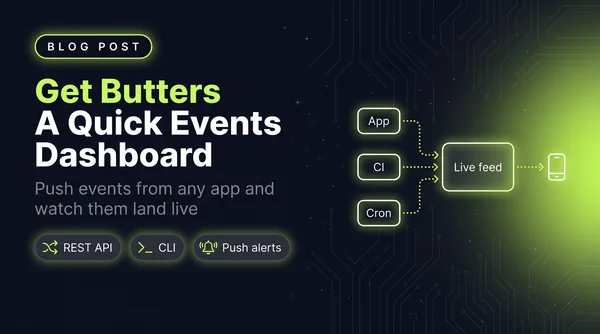
I wanted a simple dashboard that showed me events as they happened, so I wrote a quick little Astro app. It grew into Get Butters: a real-time event feed with a REST API, a CLI, insight cards and push alerts.
Read more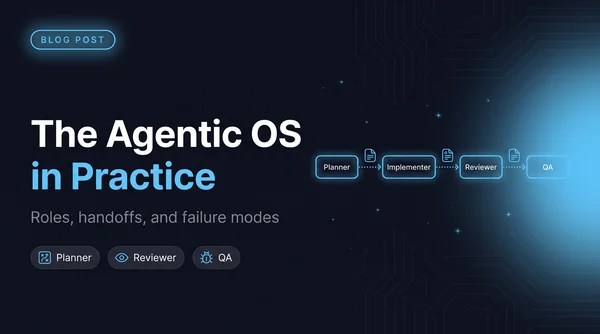
Once four agents can edit the same repo, architecture stops being the hard problem and coordination starts. The five roles I run and what each one is forbidden to touch, why every handoff goes through a file, a worktree script so agents stop racing, and the failure modes worth naming.
Read more