The First 90 Days
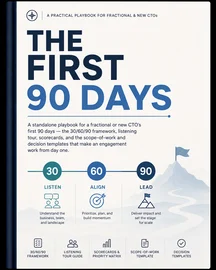
A standalone playbook for a fractional or new CTO's first 90 days — the 30/60/90 framework, listening tour, scorecards, and the scope-of-work and decision templates that make an engagement work from day one.
Read guideCareer growth, roadmaps, and the evolving engineering role.
A standalone playbook for a fractional or new CTO's first 90 days — the 30/60/90 framework, listening tour, scorecards, and the scope-of-work and decision templates that make an engagement work from day one.
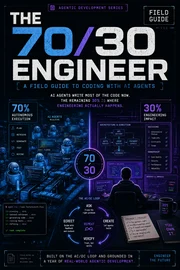
Read guideThe machine does about 70% of the typing now. That part is real, and it's not going back in the box. But the work that's left — guiding the agent, verifying what it produces, and owning the result — is the other 30%, and it turns out that 30% is the entire job. This is a field guide to working that way on purpose: a real, adoptable workflow for coding with agents, built on the AC/DC loop (Guide, Generate, Verify, Solve), grounded in what a year of agentic development actually taught the industry — the wins, the data, and the failure modes nobody likes to talk about. It's for the engineer who wants to be faster without shipping 1.7x more bugs to prove it.
Read guideIt's 3 AM, and you're staring at a production issue that's affecting 15% of your users. The error logs are cryptic, the stack trace points to three different microservices, and your team lead is asking for an ETA on the fix. Six months ago, this would have meant hours of debugging, context switching between monitoring tools, and probably a very late night. But tonight is different. You paste the error details into Claude, describe the user impact, and within minutes you have a clear diagnosis: a race condition in your payment processing service triggered by a recent deployment. More importantly, you have a tested fix and a deployment strategy that minimizes risk. What used to be a 4-hour debugging session just became a 20-minute resolution. This isn't science fiction—it's the new reality for product engineers who have learned to work alongside AI. After two decades in this field, building everything from travel platforms to AI automation tools, I've witnessed many technological shifts. But nothing has transformed my daily workflow quite like the AI revolution we're experiencing right now. The difference between traditional developers and product engineers has never been more important. While developers optimize for technical elegance, product engineers think backwards from user needs. We're the bridge between "what's technically possible" and "what actually solves problems." And AI doesn't just make us faster coders—it amplifies our ability to maintain that crucial product context while handling increasing technical complexity. In this guide, you'll discover how to build an AI-enhanced development workflow that spans from initial product discovery to deployment and monitoring. I'll share the specific tools and integrations that have transformed not just my productivity, but my ability to deliver user value faster and more reliably. You'll see real examples from recent projects, learn a framework for evaluating AI tools, and understand how to implement these changes without disrupting your team's existing rhythm. This matters more than ever because we're at an inflection point. Recent data shows that 76% of product leaders expect their AI investment to grow in 2025, and developers using GitHub Copilot report up to 55% productivity improvements without sacrificing code quality. But here's what the statistics don't capture: AI isn't just making us faster—it's making us better product engineers by freeing us to focus on the strategic, creative, and deeply human aspects of building products that people love. The developers who thrive in the next decade won't be those who resist AI or those who blindly adopt every new tool. They'll be the ones who thoughtfully integrate AI as a force multiplier for product thinking, user empathy, and creative problem-solving. If you're ready to become one of them, let's dive in.
Read guide