Field Guides Tagged as "Automation"

Workflow automation and orchestration.

← All field guides

The Agentic Playbook

The Agentic Playbook

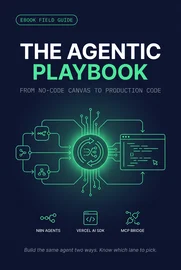
Everyone agrees you should be building agents. Nobody agrees on how. One camp says drag nodes on a canvas and ship this afternoon. The other says real agents live in code, in your repo, behind your own API. They're both right, and the argument is a distraction: the loop is the same either way. A model, a set of tools, a memory, and a stopping condition. Once you see that, the question stops being "which side is right" and becomes "which lane fits this job." This playbook walks both lanes properly. The first half builds agents in n8n: the AI Agent node, tools it can actually call (including MCP servers), memory and RAG on the canvas, human approval gates, multi-agent patterns, and the Evaluations feature that tells you whether any of it works. The second half builds the same ideas in TypeScript with the Vercel AI SDK inside an Astro site: a streaming chat endpoint, real tool definitions with schemas, the ToolLoopAgent, approval gates in code, structured output, and MCP as the bridge that lets your n8n workflows and your code agents share the same tools. It pairs with [Mastering n8n](/guides/mastering-n8n) (which covers hosting and hardening the platform itself) and [Roll Your Own Coding Agent](/guides/roll-your-own-coding-agent) (which builds the raw loop from nothing), and once you're shipping agents, [QA in the Era of AI](/guides/qa-in-the-era-of-ai) shows what happens when you point them at your test suite. This one is about shipping: picking a lane, building the agent, and knowing when to switch lanes as the job outgrows the canvas. _This is a living document and will be updated as the tools and patterns evolve._

Read guide
QA in the Era of AI

QA in the Era of AI

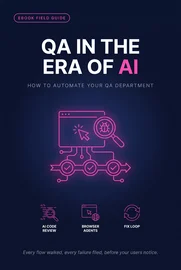
I've worked at companies with entire QA departments: rooms of people clicking through the same flows before every release, filing tickets, arguing about repro steps. Most of that job is now something you can wire up. Not because testing got less important, but because agents got good at exactly the parts that burned humans out: reviewing every pull request, walking the same three flows every morning, catching the console error nobody looked for, filing the ticket with the screenshot actually attached. This guide is the system for doing that on purpose. It started with [a post about my dialer QA bot](/blog/how-to-use-claude-code-to-qa-your-website), where Claude Code drives a browser through real call flows and files GitHub issues for whatever breaks. Here we build the whole department around that idea: AI code review as the first gate (and the real tradeoffs between the tools), agents that write tests plus the mutation-testing trick that keeps those tests honest, browser agents that smoke-test every preview deploy, visual and accessibility passes, and the loop that turns every failure, from staging or production, into a filed issue that another agent fixes. (And if you want to build agents like these yourself, that craft is [The Agentic Playbook](/guides/the-agentic-playbook); this guide is about putting them to work.) And because I'd rather you trust this thing for the right reasons, we spend real time on where it breaks: agents that pass tests they should fail, self-healing tools that heal around genuine bugs, prompt injection hiding in the very pages your QA agent reads, and the work that still belongs to a human with product judgment. The goal isn't zero humans. It's humans doing the 30% that was always the actual job, with a tireless department underneath them. _This is a living document and will be updated as the tools and patterns evolve._

Read guide
Mastering n8n

Mastering n8n

If Directus is the first thing I stand up on a new project, n8n is the second. It's the workflow automation tool I reach for whenever something needs to talk to something else — webhooks, scheduled syncs, API orchestration, and increasingly, AI agents that actually do work instead of just chatting. The pitch is simple: a visual canvas where each node is a step, the data flows down the chain, and you can drop into real JavaScript any time the visual builder runs out of road. Self-host it on a single box, point it at Postgres and Redis, and you've got a durable automation engine you fully own — no per-task pricing, no vendor watching your data go by. This is the guide I'd hand a developer who's tired of gluing services together by hand: how to self-host n8n properly with Docker and queue mode, how the data model and expressions actually work, how to handle errors like you mean it, how to build real AI agents with the LangChain nodes, and how to wire it up to Directus so the two cover each other's weak spots. _This is a living document and will be updated as n8n updates._

Read guide